





NPA Sustains Nigeria Export Growth By 25% In 2 Years

Nigerian Ports Authority (NPA) has sustained Nigeria’s export growth by over 25 per cent in the last two years owing to the policies of the Federal Government.
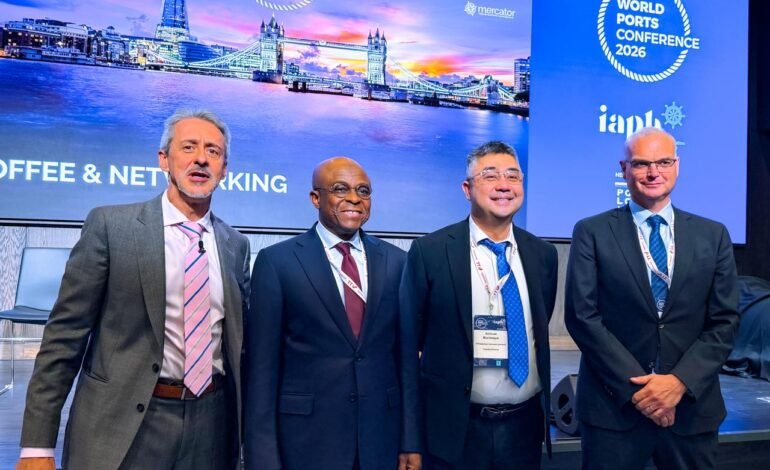
The Managing Director of the authority, Dr Abubarkar Dantsoho, stated this at the ongoing Annual World Ports Conference in London, organised by the International Association of Ports and Harbours (IAPH).
Dantsoho said that NPA had everything in place to sustain the growth in exports, adding that it was the reason it set up the Export Processing Terminal (EPT).
According to him, Nigeria’s population gives it an immense advantage among its peers in West and Central Africa, adding that recent reforms have also massively increased cargo throughput.
He explained: “So for us in Nigeria, the most important thing is that we are seeing growth as a result of this policy that we are taking.
“Statistically, the exports from Nigeria in the last two years have increased by 25 per cent, and these are exports that are not mainly only oil and gas; in terms of oil and gas, as I mentioned, we are doing fantastically around that, but then also in the other areas of manufacturing and agriculture, you know, raw materials like cocoa, like cashew and all that.
“Volumes have increased, and that is to the credit of the partnership that we have between ourselves and the major terminal operators, APM Terminals.
“We have got about four of those in Nigeria where we collaborate with the terminal operators, with the Nigeria Customs Service (NCS), and other agencies that have a stake. So that everything regarding the processing of the cargo for export is done locally, so that by the time it is exported out of Nigeria, there will not be issues regarding standards.”
The managing director stressed that Nigeria was better placed today to take advantage of the African Continental Free Trade Agreement (AFCTA) as a result of the reforms of the present administration.
He noted that Nigeria’s economy was very strong now because of the president’s reforms, which everyone could testify were attracting investors to the country.
Dantsoho explained: “So because of that, we are leading other African countries to ensure that we export or trade within ourselves in a free and fair manner.
“So between, for example, Nigeria and Morocco, there’s a lot of exchange of ideas because Morocco is now a hub for manufacturing of electric cars and other smaller cars.”
The reforms, he added, were the reason why Nigeria had two ports in the top 20 in the latest global ports ranking by the World Bank.
He said the Federal Government, in planning for the medium to long term, is investing $1 billion to expand and modernise the Apapa ports.
Dantsoho noted: “So expansion and modernisation of infrastructure requires that we collaborate with private sector people. And in that area, as I said, we are working with APMT; we are working with other bigger players who have got the capital.
“But this is a project that requires a lot of investment. You have to put a lot of money into it to be able to do that. We are also working with some partners to develop our technology. So, for example, in recent times, like a year ago, we had a partnership with a firm from Singapore.
“We have developed a simple window system. And right now, we are also working with another company from Abu Dhabi to develop the port community system. It is not only us partnering with the private sector, but there’s also a business-to-business relationship in the private sector.”