






SPE Lauds FG For Successful Licensing Round
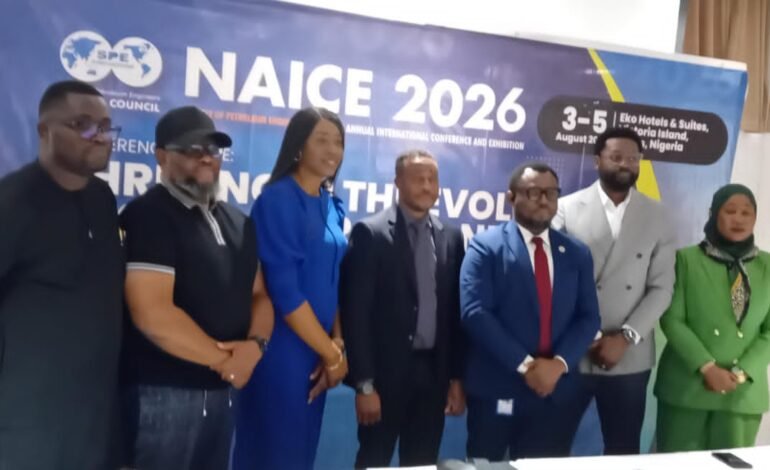

The Society of Petroleum Engineers (SPE) Nigeria Council on Tuesday commended the Federal Government, the Ministry of Petroleum Resources, and the Nigerian Upstream Petroleum Regulatory Commission (NUPRC) for conducting an automated, market-driven process under the Petroleum Industry Act (PIA).
Chairman, SPE Nigeria Council, Engr. Francis Nwaochei, during a media briefing in Lagos also described as transparent the just concluded 2025 Licensing Round in Abuja, in which NUORC awarded 37 oil and gas blocks across mature and frontier basins to 31 preferred bidders.
He stated that the Nigeria Annual International Conference and Exhibition (NAICE 2026) will serve as the first major industry platform where the operational and commercial execution of these newly awarded assets will be decoded.
He said: “Awarding blocks is only the catalyst; converting exploration licenses into daily producing volumes requires rapid technology deployment, reservoir precision, and disciplined capital mobilization. This directly supports Nigeria’s national target of achieving 3 million barrels per day (bpd) by 2030.
“Concurrently, the ongoing portfolio rebalancing by International Oil Companies (IOCs) toward deepwater assets has placed indigenous independent operators at the center of domestic onshore and shallow-water production which is now accounting for roughly 60% of national supply.
“Indigenous companies must demonstrate both operational excellence and financial bankability as they assume asset stewardship, manage decommissioning liabilities, and drive field optimization.”
He added:”This year’s theme, “Thriving in the Evolving Global Energy Landscape: Collaborative Growth and Resilience,” directly reflects the structural realities facing our sector today. Globally, investment flows, technology adoption, geopolitics, and decarbonization strategies are shifting rapidly. Energy security and environmental sustainability can no longer be treated as distinct agendas—they must advance in tandem.
“For Africa, resilience cannot be a passive defense against market volatility; it must be an active, competitive strategy. Our continent faces the dual imperative of eliminating energy poverty and accelerating industrial growth while managing environmental expectations.
These goals cannot be achieved in silos. True resilience requires an integrated ecosystem where regulators, operators, service providers, technology developers, and financial institutions align to drive down unit operating costs, de-risk investments, and unlock capital.
As a neutral, non-political technical body, “SPE Nigeria Council provides the definitive platform to convert these strategic imperatives into execution.”
Nwaochei stated that in the downstream, the scaling of world-scale private refineries alongside modular facilities is turning Nigeria into a regional refining hub.
He added that sustainable energy security requires commercial harmony: enforcing Domestic Crude Supply Obligations (DCSO) under the PIA while preserving market-based returns and contract sanctity for upstream producers.
He said that reaching 3 mbpd by 2030 requires moving beyond recovering shut-in production to executing greenfield developments and subsea tie-backs.
He stated that where questions arise regarding OPEC+ quota ceilings, SPE’s technical position is clear. He advised Nigeria must first build redundant, reliable production capacity.
He added that expanding gas commercialization and maximizing condensate volumes which fall outside OPEC crude limits—provide immediate fiscal runway.
The Council chairman said that to fund these capital-intensive projects amid Western commercial bank pullbacks under ESG mandates, Africa is structuring its own financial solutions.
He added that the operationalization of the African Energy Bank (AEB) in Abuja, by September this year hopefully, alongside regional syndicates and private equity, provides a critical framework to secure energy sovereignty and capital access.
Nwaochei said that on infrastructure security, technical solutions—such as digital twin monitoring, fiber-optic pipeline surveillance, and automated metering—are essential technical safeguards.
He, however, said that technology must operate alongside the Host Community Development Trusts established under the PIA to ensure lasting security across production corridors.
He stated that NAICE 2026 offers a comprehensive, outcome-focused program including Pre-Conference Continuing Education, a specialized short courses delivered by global domain experts prior to the conference flag-off.
He added that it will feature over 600 peer-reviewed technical papers and e-posters covering reservoir management, drilling engineering, AI integration, deepwater operations, and carbon capture.
According to him, the summit will have
executive panel sessions, topical issues workshops, international exhibition, specialised workshops and mentorship, women leadership programme, among others.