


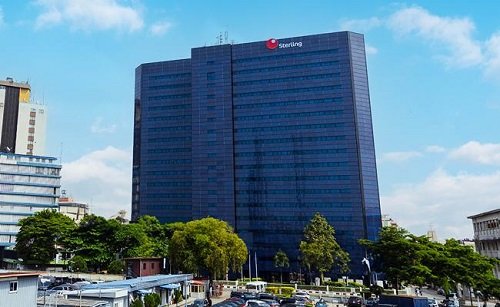
Sterling Financial Holdings Company Plc has reported a 20.95 per cent increase in profit after tax to N75.37 billion for the nine months ended September 30, 2026, compared with N62.30 billion recorded in the corresponding period of 2025.
The financial services group disclosed this in its unaudited interim financial statements filed with the Nigerian Exchange Limited (NGX), showing improved earnings driven by growth in interest income, net interest income and other operating income.
The group’s gross earnings rose by 33.15 per cent to N454.94 billion from N341.67 billion in the corresponding period of 2025, reflecting increased income generation across its operations.
Profit before tax also increased by 37.09 per cent to N97.28 billion from N70.96 billion recorded in the previous year, while income tax expenses rose to N21.91 billion from N8.66 billion.
The results showed that Sterling Financial Holdings sustained earnings growth despite higher operating expenses and credit loss charges during the review period.
Interest income increased to N353.78 billion from N262.42 billion, representing a growth of approximately 34.8 per cent. Interest expenses, however, rose to N147.88 billion from N119.38 billion.
Consequently, net interest income advanced to N205.90 billion from N143.04 billion, representing an increase of 43.95 per cent.
Net fees and commission income also grew to N39.63 billion from N35.88 billion, while net trading income stood at N21.30 billion, compared with N22.78 billion in the corresponding period of 2025.
Other operating income rose to N40.23 billion from N20.59 billion, contributing to the group’s overall revenue growth.
Total operating income increased to N307.06 billion from N222.29 billion, indicating stronger earnings capacity during the period.
However, the group’s operating expenses increased, reflecting cost pressures across its business operations.
Personnel expenses rose to N54.21 billion from N40.56 billion, while other operating expenses increased to N46.99 billion from N40.75 billion.
General and administrative expenses climbed to N47.54 billion from N41.17 billion, while other property, plant and equipment costs stood at N11.89 billion, compared with N14.68 billion in the corresponding period of 2025.
Depreciation and amortisation expenses increased to N8.85 billion from N6.09 billion.
Total expenses rose to N169.49 billion from N143.24 billion, reflecting higher personnel, administrative and other operating costs.
Credit loss expenses on financial assets increased to N40.28 billion from N8.09 billion, highlighting the impact of increased impairment charges on the group’s financial performance.
Despite the increase in credit loss expenses and operating costs, profit before tax grew by more than 37 per cent, while profit after tax advanced by approximately 21 per cent.
Earnings per share declined to N11.35 from N12.82 in the corresponding period of 2025. The company noted that basic and diluted earnings per share for both periods had been restated following the reconstruction of one new ordinary share for every 10 existing ordinary shares, effective October 8, 2026.
The group’s non-performing loan ratio improved slightly to 4.6 per cent as of September 30, 2026, from 4.7 per cent at the end of December 2025, indicating a marginal improvement in asset quality.
Sterling Financial Holdings’ total assets increased to N5.10 trillion as of September 30, 2026, from N3.91 trillion at the end of December 2025, representing growth of approximately 30.4 per cent.
Loans and advances to customers rose to N1.82 trillion from N1.41 trillion, while cash and balances with the Central Bank of Nigeria stood at N725.27 billion, compared with N761.64 billion at the end of 2025.
Investment securities also increased, with debt instruments measured at fair value through other comprehensive income rising to N1.16 trillion from N646.47 billion.
Deposits from customers grew to N3.84 trillion from N2.98 trillion, reflecting an expansion in the group’s deposit base.
Total liabilities increased to N4.50 trillion from N3.48 trillion, while shareholders’ equity rose to N595.16 billion from N428.70 billion.
Retained earnings increased to N124.38 billion from N65.89 billion, while share capital rose to N34.25 billion from N27.35 billion.
The increase in total assets, customer deposits and shareholders’ equity reflects the group’s expanded balance sheet during the nine-month period.
For the third quarter ended September 30, 2026, Sterling Financial Holdings recorded profit after tax of N25.08 billion, compared with N20.52 billion in the corresponding quarter of 2025, representing growth of approximately 22.2 per cent.
Profit before tax rose to N41.75 billion from N41.51 billion, while gross earnings increased to N130.21 billion from N95.26 billion.
Net interest income advanced to N68.51 billion from N45.63 billion, reflecting stronger interest income generation.
However, total expenses increased to N55.46 billion from N51.14 billion, while credit loss expenses stood at N16.43 billion compared with N8.27 billion in the corresponding quarter of 2025.
The quarterly results indicate that stronger operating income supported profit growth despite rising expenses and impairment charges.
Sterling Financial Holdings operates as a non-operating financial holding company, with investments in subsidiaries approved by its board and in accordance with the Central Bank of Nigeria’s permissible activities.
Its subsidiaries include Sterling Bank Limited, a commercial bank; Alternative Bank Limited, a non-interest bank; and SterlingFI Wealth Management Limited, an asset management company.
The holding company was incorporated on October 13, 2021, re-registered as a public company on November 16, 2022, and listed on the Nigerian Exchange on April 6, 2023. The Central Bank of Nigeria issued its final licence on June 27, 2023, and the company commenced operations on July 1, 2023.
Source: Business Archives – New Telegraph


