


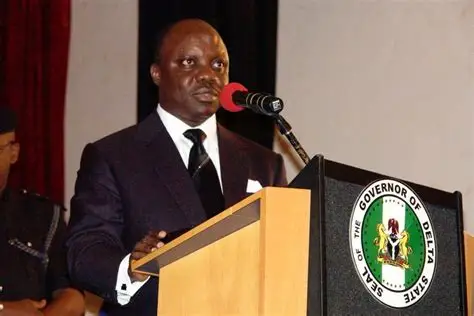
Things to know about late ex-Delta governor, Emmanuel Uduaghan
Late former Delta State Governor, Dr Emmanuel Uduaghan, was a medical doctor and politician who governed the oil-producing state for eight years, from 2007 to 2015.
Uduaghan, who died on Monday, October 19, 2026, aged 71, held several public offices before becoming governor. His administration focused on healthcare, infrastructure, peace and security, and economic diversification.
Here are things to know about the late former governor.
1. He was born in Delta State
Uduaghan was born on October 22, 1954, in Warri North Local Government Area of Delta State. He was of Itsekiri origin and was born to Chief Edmund D. Uduaghan and Mrs Cecilia Uduaghan.
He attended Baptist Primary School, Mosogar, from 1961 to 1966, and Federal Government College, Warri, from 1968 to 1974.
2. He trained as a medical doctor
Uduaghan studied medicine at the University of Benin between 1975 and 1980, obtaining a Bachelor of Medicine and Bachelor of Surgery degree. He later earned a diploma in anaesthesia.
He began his medical career in 1983 as a medical officer at the Delta Steel Company. He subsequently worked at Westend Hospital in Warri, Benoni Hospitals in Benin City and Shell Hospital in Ogunu as a consultant anaesthesiologist.
In 1994, he established a private medical practice. He was also active in the Nigerian Medical Association and the Junior Chamber International, popularly known as Jaycees.
3. He served as Delta Commissioner for Health
Uduaghan began his career in public office under former Delta State Governor James Ibori, his first cousin.
On August 6, 1999, Ibori appointed him Commissioner for Health, a position he held until 2003. His responsibilities included overseeing healthcare delivery and related infrastructure in the state.
On June 6, 2003, he was appointed Secretary to the State Government, serving in the role until 2007.
4. He became governor in 2007
Uduaghan emerged as governor under the Peoples Democratic Party in 2007, succeeding Ibori.
His emergence followed a disputed electoral process. The initial election was later annulled, and he returned to contest a re-run in January 2011.
He won re-election in April 2011, defeating Great Ogboru of the Democratic People’s Party, and remained in office until May 29, 2015.
He was succeeded by Ifeanyi Okowa.
5. He pursued a ‘Delta Beyond Oil’ vision
One of the defining initiatives of Uduaghan’s administration was the “Delta Beyond Oil” vision, which sought to reduce the state’s dependence on crude oil revenue by developing other sectors of the economy.
The initiative emphasised agriculture, tourism, small and medium-sized enterprises, investment and other economic activities.
6. His administration focused on healthcare
Healthcare was one of the major areas associated with Uduaghan’s administration, reflecting his professional background as a medical doctor.
His government pursued maternal and child healthcare programmes, including initiatives aimed at providing free healthcare services for pregnant women and children under five.
His administration also supported the development of the Delta State University Teaching Hospital in Oghara.
7. He pursued infrastructure and education projects
Infrastructure development was another pillar of Uduaghan’s three-point agenda, alongside peace and security and human capital development.
Projects associated with his administration included road construction, the development of Asaba International Airport and expansion works at Osubi Airport.
In education, his government pursued school rehabilitation, classroom construction, bursaries and scholarship programmes aimed at improving access to education.
8. He was involved in peace and security efforts
Security challenges in the Niger Delta were among the major issues confronting Uduaghan during his time in office.
His administration pursued engagement with communities and groups in the creeks as part of broader efforts to address militancy and instability in the oil-producing region.
Peace and security became one of the central priorities of his governorship, alongside infrastructure and human capital development.
9. He contested for the Senate after leaving office
After completing his two terms as governor in 2015, Uduaghan remained active in politics.
In 2019, he contested the Delta South Senatorial District seat but lost to the PDP’s James Manager.
He left the PDP for the All Progressives Congress in August 2018, returned to the PDP in 2020 and announced his retirement from active politics in 2022.
In May 2025, he rejoined the APC.
10. He was married to Roli Uduaghan
Uduaghan was married to Roli Uduaghan, the daughter of retired Brigadier-General Sunny E. Tuoyo, a former military administrator of Ondo State.
Their children included Orode Uduaghan, who has held public office in Delta State, and Toritseju, also known as Toju.
11. He was known as the ‘Talk and Do Governor’
Uduaghan was sometimes referred to as the “Talk and Do Governor”, a nickname associated with his public image and approach to governance.
His eight-year administration was linked to initiatives in healthcare, education, infrastructure, security and economic diversification.
12. He died days before his 72nd birthday
Uduaghan died on October 19, 2026, aged 71, three days before his 72nd birthday on October 22.
His death was announced in a statement issued by his family.
All rights reserved. This material, and other digital content on this website, may not be reproduced, published, broadcast, rewritten or redistributed in whole or in part without prior express written permission from PUNCH.
Contact: [email protected]
Stay informed and ahead of the curve! Follow The Punch Newspaper on WhatsApp for real-time updates, breaking news, and exclusive content. Don’t miss a headline – join now!
Stay in the know—fast. Get instant alerts, breaking headlines, and exclusive stories with the Punch News App. Download now and never miss a beat.
Source: Punch Newspapers – Latest News


