


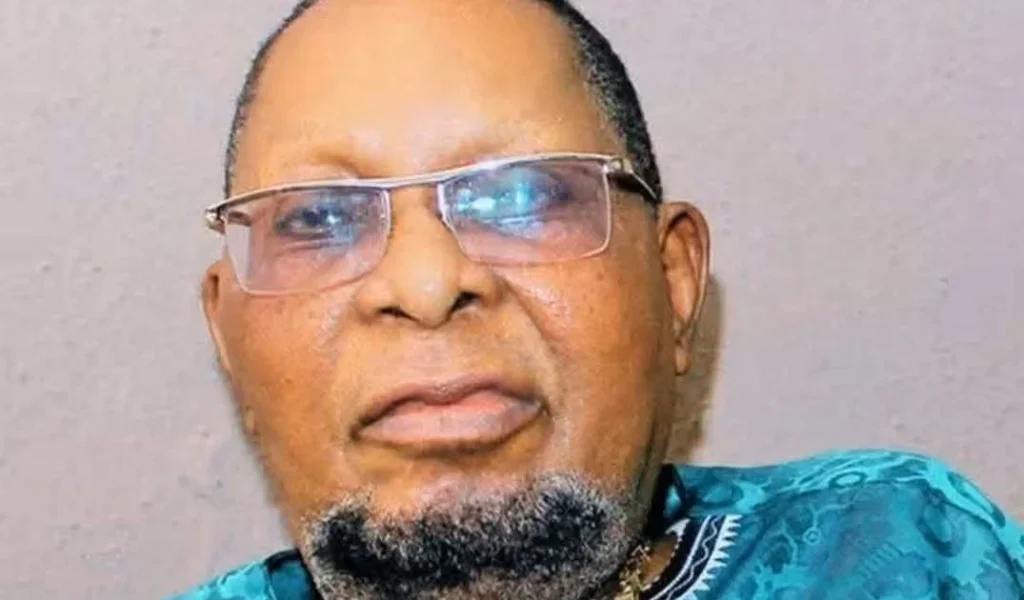
Things to know about late Mushin strongman Baba Alado
The death of Chief Taoreed Faronbi, popularly known as Baba Alado, has brought to an end the life of one of the prominent figures in Mushin’s political, social, traditional and commercial circles.
Faronbi, who died at the age of 83 in the early hours of Saturday, was buried according to Islamic rites later that day.
For decades, he remained a familiar figure in Lagos grassroots politics, the social scene, traditional affairs, and the transport sector, with enduring years of controversy.
Here are things to know about the late Mushin strongman:
1. He was the Olori Ebi of the Alagbeji Royal Family
Faronbi was the fifth head, or Olori Ebi, of the Alagbeji Royal Family in Papa Ajao, Mushin.
He was installed in November 2015, succeeding Alhaji Chief Taiwo Shittu Apena, who had died nine years earlier.
His selection was reportedly agreed by the four families that make up the royal family: Apena, Arowoye/Ejoga, Akinlagun and Alabe.
2. He was a prominent Mushin political figure
For decades, he was a prominent player in Lagos grassroots politics, known as a mobiliser and power broker whose influence stretched across Mushin and other areas. He was a chieftain of the All Progressives Congress (APC).
In 2020, a former Mushin Local Government chairman listed Faronbi among community and political leaders who supported his administration. The current Mushin LG Chairman, Tunbosun Aruwe, also described him as a father figure, mentor, leader and political stalwart.
3. Influential godfather in politics, transport and market sectors
Farounbi was widely regarded as a heavyweight leader and influential patron within the National Union of Road Transport Workers in Lagos, particularly in the Mushin axis and surrounding areas.
In local political and street circles, he was often described as the “Adedibu of Mushin” — a reference to the late Lamidi Adedibu, the legendary Ibadan strongman and political godfather.
In his prime, he was seen as the No. 1 NURTW patron and a godfather figure to many NURTW chiefs and area boys across parts of Lagos. His loyalists, commonly referred to as “Alado boys,” were frequently linked to the rough-and-tumble of local power struggles and multiple controversies in Mushin and beyond.
He also served as Babaloja (market leader) of Aswani International Market.
National NURTW President Musiliu Akinsanya, popularly known as MC Oluomo, and other transport stakeholders mourned his death.
4. Celebrated socialite and patron of musicians
He was a prominent Lagos socialite whose name featured in songs by leading Fuji and related musicians, including K1 De Ultimate, Saheed Osupa and Alabi Pasuma.
He maintained a high-profile social presence for decades, often appearing with large entourages at events.
5. Controversy over 2020 attack
The late strongman was linked to a 2020 violent incident that occurred in the White Sand community area of Isheri-Osun, Lagos, reportedly over a boundary zone between Festac/Amuwo-Odofin and Isheri-Oshun.
Two men were killed, reportedly by machete wounds. Other people were injured, and property was damaged.
The Kuje royal family (Amuwo side) publicly accused Alado of sponsoring or supervising the attack as an agent for the opposing Fagbile Isheri-Oshun family interests.
In late 2020, the Federal Government, through the Attorney-General of the Federation, filed a three-count charge (marked FHC/L/279c/2020) against Farounbi and six co-defendants — Alhaji Olusegun Akinde (alias Echo), Ayokunle Fakiyesi, Idowu Akinde, Musiliu Oladejo, Lekan Matthew, and Adeleke Akindeji — before the Federal High Court in Lagos.
The charges alleged conspiracy and participation in acts of terrorism under Section 1(2)(a) of the Terrorism Prevention Act 2011 (as amended), leading to the two deaths and the destruction of property in the White Sand area on 19 March 2020.
6. Violence and denial
Farounbi consistently rejected claims that tied him to specific violent incidents.
In February 2011, following a crisis in the Idi-Araba axis of Mushin that claimed the life of a Hausa resident, a newspaper report linked him to leading a faction of the Oodua People’s Congress (OPC) in the clashes.
In a response published by PM News, Farounbi denied any involvement.
He stated he neither belonged to the OPC nor (at that time) the National Union of Road Transport Workers as alleged, and said he was in Ghana on the day of the mayhem, offering to prove it with his international passport entries.
He expressed surprise that he had not been contacted for his side of the story before publication.
Separately in 2011, security reports linked him to factional tensions in Mushin involving NURTW and street groups; the State Security Service (SSS) arrested him at his Isheri Osun residence and reportedly recovered pump-action guns and ammunition.
In January 2016, after a gang clash in Mushin left several people injured and vehicles burnt, Farounbi publicly urged the police to identify and arrest the true sponsors of the unrest rather than linking his name to every crisis.
He stated that none of his children was involved (noting they lived abroad in the UK, US, South Africa and elsewhere) and rejected any suggestion that he bred or controlled the hoodlums.
During the #EndSARS protests in October 2020, social media and reports alleged he had sponsored thugs to attack protesters in the Alausa area of Lagos.
In a telephone interview with The PUNCH, Farounbi strongly denied the claim.
He said he was shocked to be trending, had not visited Alausa in almost 15 years, had no interest in the area or the protests, and spent much of his time in America.
He described the accusations as lies, said anyone caught with weapons disrupting protests should face justice, and suggested politicians were behind such attacks. He noted that he was frequently accused of land-related matters but had “no hand” in the Alausa incidents.
7. He was remembered as a father figure and political mentor
Faronbi remained active in political and community affairs until his later years, earning the respect of some younger political figures in Mushin.
Mushin Local Government Chairman, Tunbosun Aruwe, described his death as a deeply personal loss in a tribute issued on Saturday.
“It is with a deeply saddened heart and a profound sense of loss that I extend my heartfelt condolences to the family of Late Chief Alhaji Taoreed Faronbi (Alado), my father figure, my mentor, my leader and our respected political stalwart, who passed away today, 26th September, 2026,” Aruwe said.
He added that Faronbi was more than a political colleague.
“Late Chief Alhaji Taoreed Faronbi was more than a political associate; he was a father figure, a trusted elder and a man whose guidance, wisdom, fatherly counsel and presence meant so much to me.”
Aruwe said the void left by Faronbi’s death could not easily be put into words, adding, “His contributions to the political and community life of our people will also remain part of the legacy he leaves behind.”
8. Previous death rumours
For several years before his confirmed death in September 2026, Baba Alado was the subject of recurring false reports and rumours about his demise and health.
In April 2024, he personally appeared in a video to debunk one such wave of death rumours.
All rights reserved. This material, and other digital content on this website, may not be reproduced, published, broadcast, rewritten or redistributed in whole or in part without prior express written permission from PUNCH.
Contact: [email protected]
Stay informed and ahead of the curve! Follow The Punch Newspaper on WhatsApp for real-time updates, breaking news, and exclusive content. Don’t miss a headline – join now!
Stay in the know—fast. Get instant alerts, breaking headlines, and exclusive stories with the Punch News App. Download now and never miss a beat.
Source: Punch Newspapers – Latest News


